Stuff Blowing Up

On highlight reels, hollow empires, and the ancient art of not knowing you’ve already lost.
There is a war on. A real one, with real ordinance and real bodies and real consequences that will be felt in fuel prices and food supply chains and geopolitical realignments for decades. The Strait of Hormuz is closed. The International Energy Agency has called it worse than both 1970s oil shocks combined. More than two thousand people are dead and the number is climbing with the reliable momentum of all such numbers once they get started.
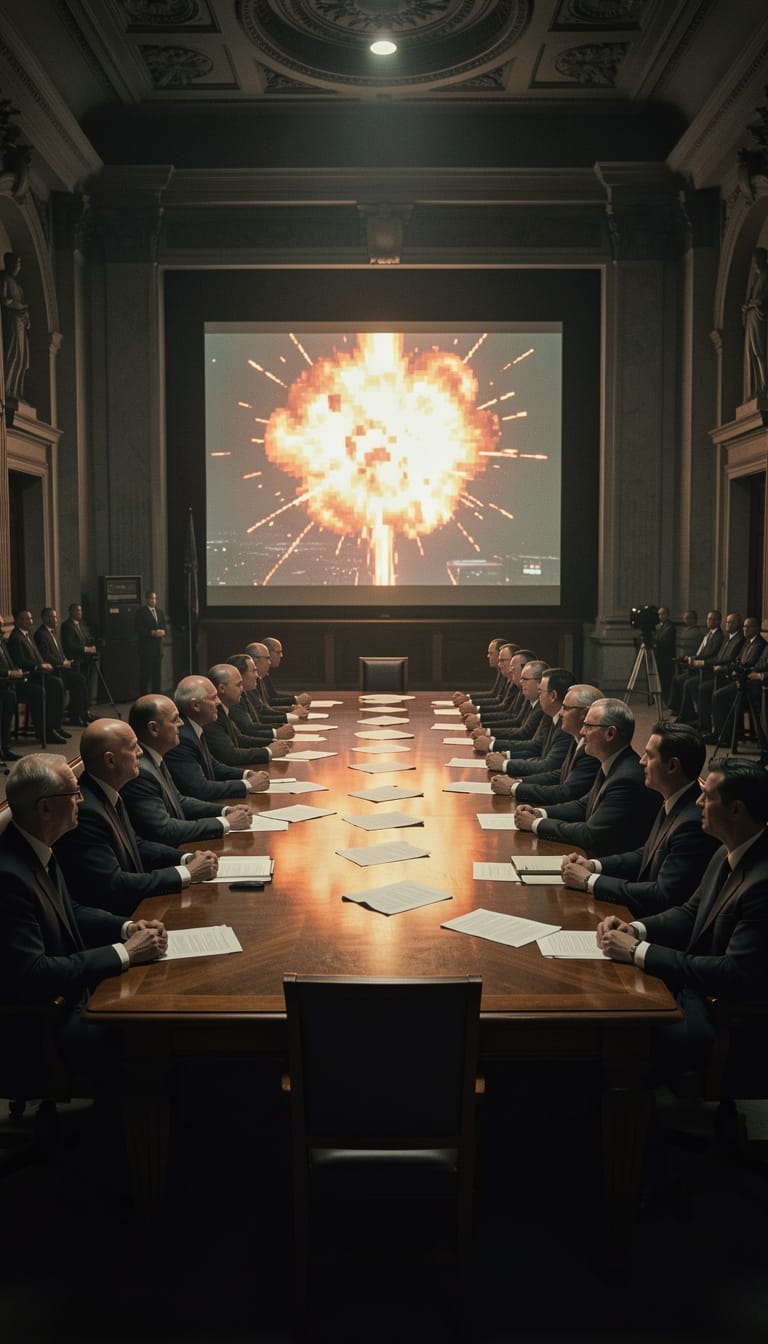
And the man commanding the American response is being briefed, daily, via a curated video montage of things exploding.
That’s not my characterisation. That’s the phrase an official inside his own administration used. Stuff blowing up. Two minutes. Highlights only. The President of the United States is receiving his daily intelligence briefing in a format previously reserved for football retrospectives and action movie trailers.
I want to sit with that for a moment, because I think the temptation is to treat it as a Trump story... as evidence of one particular man’s particular relationship with information and attention spans... and move on. That would be a mistake. That would be, in fact, exactly the kind of editorial decision that got us here.
This isn’t a Trump story. This is an empire story. And if you’re British, you’ve seen it before. You’ve lived it before. You just didn’t have the decency to film it quite so efficiently.
Every empire, without exception, develops an increasingly sophisticated mythology of its own invincibility.
This is not a controversial historical observation. It’s practically a law. Rome did it. The Ottomans did it. The Spanish did it so thoroughly that they kept sending fleets out for a century after the model had obviously stopped working. The British... well. The British essentially industrialised the process.
We built entire institutions around the production and distribution of invincibility mythology. The BBC World Service. The Foreign Office. The particular brand of public school education designed to produce men who could lose gracefully while insisting, with impeccable diction, that they hadn’t lost at all. We lost India and called it independence. We lost Suez and called it a ceasefire. We lost the post-war economic race and called it a transition. We have been, for the better part of a century, the undisputed world champions of reframing collapse as strategy.
The highlight reel isn’t new. Britain’s been running one since roughly 1947. We just outsourced the editing to the Foreign Office rather than a video production team in the West Wing.
The difference... and this is the part that keeps me staring at the ceiling ... is the speed. The velocity of the mythmaking. The real-time, algorithmically optimised, fully monetised velocity of a civilisation that has decided, at the highest levels, that curated reality is a perfectly acceptable substitute for the actual kind.
Here is what we know, and it’s farcical enough that I’m going to present it without embellishment.
The intelligence community briefed the White House, before the strikes, that Iran would likely retaliate by targeting energy infrastructure and threatening commercial shipping if hit. This assessment existed. It was delivered. It is, by all accounts, sitting in a document somewhere with a classification stamp on it.
Then the strikes happened. Then Iran retaliated by targeting energy infrastructure and threatening commercial shipping. Then the President expressed surprise and noted that “no expert” had predicted such a response.
The experts had predicted exactly that response.
Someone, at some point in the chain between the intelligence assessment and the highlight reel, made an editorial decision. Someone looked at the footage of the bit where the analysts say “if you do this, here’s what happens next” and decided that particular clip didn’t make the cut. Too slow. Bad energy. Doesn’t play well in the room.
This is not incompetence. Incompetence is chaotic and random. This has a logic to it. This is the logic of every court that ever surrounded a king with people whose primary professional skill was telling him he was winning. It is ancient. It is consistent. It is one of the most reliable predictors of eventual, catastrophic, nobody-saw-it-coming collapse in all of recorded history.
Nobody saw it coming, of course, because someone had edited out the bit where they did.
I grew up in a country that had already done this to itself.
Not dramatically. Not in one sharp moment of imperial hubris you can point to and say: there, that’s when Britain decided to stop looking at the actual picture. It was gradual. It was institutional. It was the slow, dignified, entirely voluntary retreat from reality that characterises every great power’s middle and later years.
I watched us do it with Iraq. The dossier that was, famously, sexed up. The intelligence that was shaped, curated, edited to support a conclusion that had already been reached in a room that most of the people producing the intelligence never entered. The bit about weapons of mass destruction that we now know was selected rather than assessed. The bit about forty-five minutes that was, to put it charitably, not the most conservative reading of the available evidence.
The highlight reel that time had a different production aesthetic. More PowerPoint, less montage. Same editorial logic.
And then we went in. And then it went wrong. And then, for a very long time, the official position was that it was going fine, actually, and progress was being made, and we were absolutely on course, and the people saying otherwise simply didn’t have access to the full picture.
They didn’t have access to the full picture because somebody had cropped it.
The base gets a highlight reel too.
This is the bit that the Trump-as-aberration framing consistently misses. The curation doesn’t stop at the Oval Office. It continues outward, through every algorithm and platform and media ecosystem that has spent the last decade learning, with extraordinary precision, what keeps people watching.
Eighty-two percent of self-identified MAGA voters approve of the military action in Iran. A hundred percent of them approve of Trump. These are not people who have been given a different set of facts and reached a different conclusion. These are people who have been given a different set of clips and had the same editorial decision made on their behalf.
The President gets two minutes of stuff blowing up. The base gets an extended cut. Different runtime, identical logic.
And here’s where the farce tips into something genuinely vertiginous: who, in this system, is accountable to whom? The President believes he’s winning because his briefing tells him so. The base believes he’s winning because their feed tells them so. The people doing the curating... well. They believe they’re serving the national interest, presumably, which is what people who curate reality for a living always believe, right up until the moment they have to explain to a congressional inquiry why nobody saw it coming.
Empires don’t fall because they run out of power. They fall because they run out of accurate information.
This is, again, not a particularly original observation. It’s in Gibbon. It’s in Kennedy’s Rise and Fall of the Great Powers. It’s in approximately every serious historical analysis of imperial decline ever written, sitting there in plain sight, waiting to be read by someone who isn’t currently watching a two-minute video of airstrikes with the inconvenient bits removed.
The Soviets didn’t collapse because America outspent them, exactly. They collapsed because the information flowing upward through their system had been so thoroughly filtered by so many layers of people whose careers depended on telling the right story that by the time Gorbachev arrived, the actual condition of the Soviet economy was genuinely, structurally unknown to the people nominally in charge of it. They had been running on a highlight reel for seventy years.
Britain, to its modest credit, managed its decline with rather more awareness of what was actually happening. We knew we were losing. We just developed an extraordinary talent for describing the losing as something else. Which is arguably worse, ethically, but does produce better literature.
America, it seems, has gone a different route. Skip the awareness entirely. Go straight to the production values.
I don’t know how this ends.
That’s not false modesty. Nobody knows how this ends, including the people who are ostensibly in charge of deciding. That’s rather the point. The thing about curating your own reality is that reality, the actual unedited version, continues to develop off-camera regardless. Iran’s response to the strikes was not contingent on whether it made the briefing reel. The Strait of Hormuz does not consult the West Wing’s editorial calendar. The oil price does not wait for post-production.
Events, as Harold Macmillan supposedly said, when asked what was most likely to blow a government off course. Events, dear boy. Events.
Macmillan, for what it’s worth, was the Prime Minister who presided over Suez. He watched Britain’s last serious imperial adventure collapse in real time, under American pressure, while Anthony Eden had what can only be described as a comprehensive nervous breakdown at the helm. Macmillan took over. Managed the retreat. Reframed it, with characteristic British facility, as something other than what it was.
He at least knew what it was.
There’s a version of this story that ends with someone in the room finally saying, clearly and on the record, that the clips they’ve been watching are not the whole film. That the war is not going the way the reel suggests. That the experts did, in fact, predict this, and here is the document, and perhaps we should read it.
There’s another version where nobody says it, because nobody in the room has career incentives to say it, and the reel keeps running, and the base keeps watching their version of the reel, and reality keeps developing off-camera, and one day something happens that is simply too large and too immediate to be edited out in time.
History, I’m sorry to tell you, has a strong preference for the second version.
But then, history doesn’t control the production schedule. And the production schedule, right now, is very, very good.
Stuff blowing up.
Two minutes.
Highlights only.
Dominus Owen Markham writes Unharnessed ... a publication for people done being managed. If this landed, share it with someone who needs to read it.