The Quiet Catastrophe
How We All Became Complicit in the Death of Free Speech

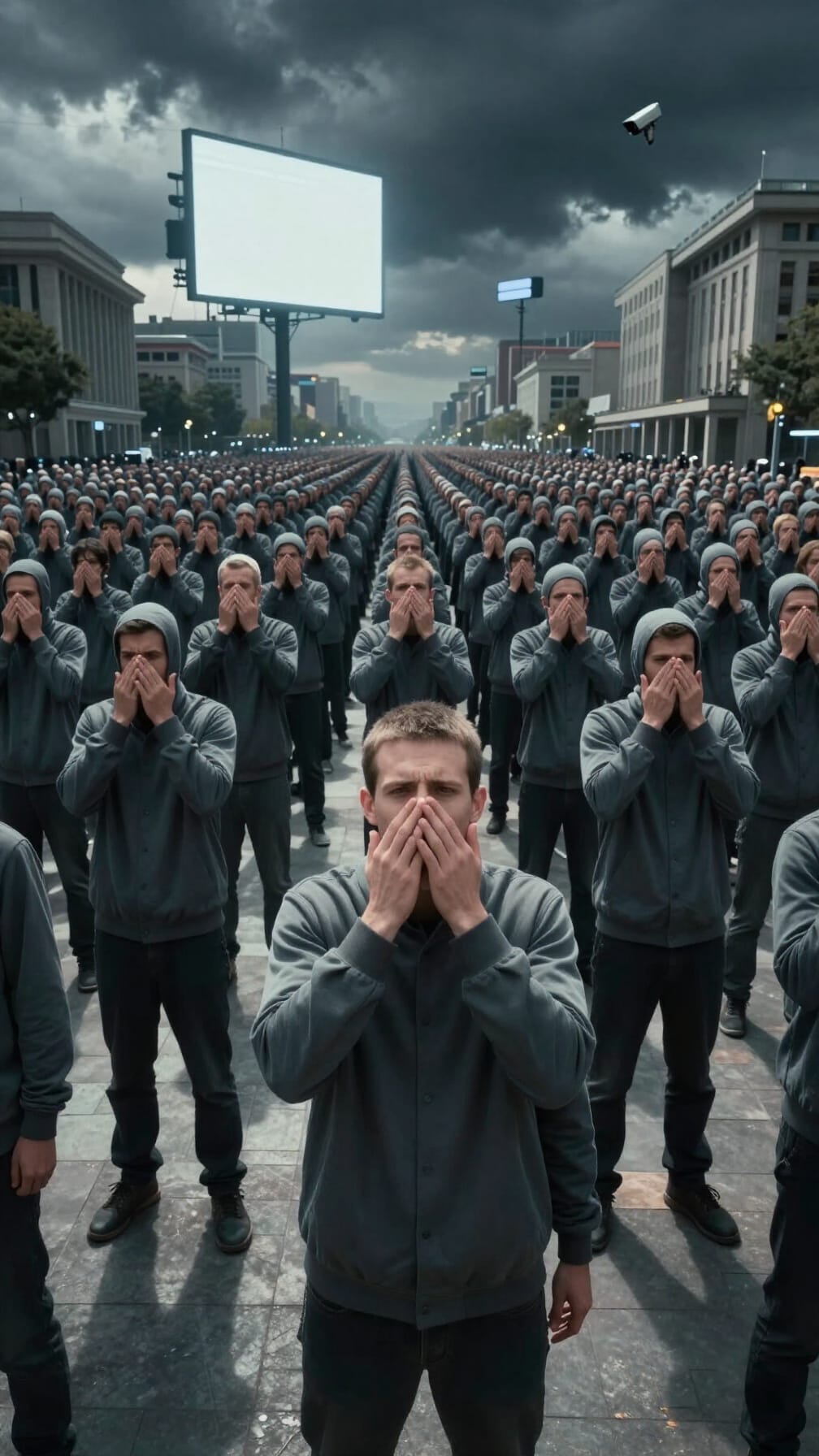
There’s a particular kind of silence that’s settled over public discourse lately. Not the comfortable silence of contemplation, or even the tense silence before a storm. This is different. This is the silence of people biting their tongues so hard they can taste blood.
We’re living through what might generously be called a catastrophic failure of nerve. Less generously? A wholesale abandonment of the principle that made the modern world possible: that people should be allowed to think, speak, and argue freely, even... especially... when they’re saying things that make us deeply uncomfortable.
And the really twisted part? We’ve somehow convinced ourselves this is progress.
The New Orthodoxy
Let me be clear about something upfront: I’m not nostalgic for some imaginary golden age when everyone could say whatever they wanted without consequences. That never existed. People have always faced social costs for unpopular opinions. The difference is what’s happened to the scale, the speed, and the permanent nature of those consequences.
Say the wrong thing now... not even something genuinely hateful, just something that violates the ever-shifting boundaries of acceptable discourse... and you can lose your job, your reputation, your livelihood. Not through any formal legal process, but through the distributed enforcement mechanism we’ve built on social media. Trial by timeline. Judgment by pile-on. Sentence: exile.
And here’s where it gets properly Orwellian: we’re not just punishing people for what they say now. We’re trawling through decade-old tweets, adolescent Facebook posts, university newspaper columns written before the author’s prefrontal cortex had fully formed. We’ve created a system where forgiveness is impossible and redemption is off the table.
The effect is predictable. People shut up. Not because they’ve changed their minds, but because they’ve learned the cost of speaking them.
The Privatisation of Censorship
Now, the free speech absolutists will tell you this is all fine because it’s not the government doing the censoring. It’s just private companies making decisions about their platforms, and if you don’t like it, you can build your own Twitter, your own YouTube, your own internet infrastructure apparently.
This is bollocks on multiple levels.
First, when a handful of companies control the infrastructure of public discourse, the distinction between state and private censorship becomes meaningless. If you’re effectively silenced, does it really matter whether it was done by a government bureaucrat or a content moderation AI trained on the sensibilities of California tech workers?
Second, these companies aren’t making these decisions in a vacuum. They’re responding to pressure from governments, from advertisers, from activist campaigns, from the constant threat of regulation. The UK’s Online Safety Act and the EU’s Digital Services Act have essentially deputised tech platforms as speech police, making them legally liable for user-generated content whilst keeping the definitions of harmful content conveniently vague.
The result is a system designed to produce over-censorship. When the penalties for allowing “harmful” content are severe and the definition of “harmful” is subjective and constantly expanding, the rational corporate response is to err on the side of silence. Remove first, ask questions never, and definitely don’t explain yourself because that creates a paper trail for regulators.
We’ve privatised censorship and then acted surprised when corporations, whose primary obligation is to shareholders rather than democratic principles, prove enthusiastic enforcers.
The Curious Case of Competing Hypocrisy
But here’s where it gets really messy: both sides of the political spectrum have completely abandoned any coherent principle about speech in favour of naked tactical advantage.
The left, which historically championed free expression as essential to social progress, now treats uncomfortable speech as violence. Words are harm. Silence is safety. The answer to ideas you disagree with isn’t debate but de-platforming. This is a catastrophic betrayal of liberal principles, dressed up in the language of care and protection.
Meanwhile, the right screams about cancel culture and Big Tech censorship whilst simultaneously demanding that schools ban books about racism or LGBTQ+ issues, that universities fire professors who criticise Israel or teach critical race theory, that protesters they disagree with face criminal charges. They want freedom of speech for themselves and their allies, censorship for everyone else.
Everyone’s a free speech warrior when their speech is being restricted. Everyone’s pro-censorship when it’s the other lot being silenced.
The result is ideological incoherence all round. We’ve lost any shared understanding of what free speech actually means or why it matters. It’s become just another weapon in the culture war, valued only insofar as it serves immediate political goals.
The Globalisation of Suppression
Zoom out to the international level and things look even bleaker.
China’s perfected the surveillance state, turning the internet into an instrument of total social control. Russia’s mastered the art of information warfare... not by controlling what people think, but by flooding the zone with so much contradictory information that truth becomes irrelevant and cynicism becomes rational. Turkey, India, Brazil, and dozens of other countries are learning from both models, finding the particular blend of censorship and propaganda that suits their needs.
And the West? We’re losing the plot entirely. We spent decades telling the world that liberal democracy was superior because it trusted people with freedom, including the freedom to be wrong, to offend, to challenge power. Now we’re implementing Chinese-style internet controls and wondering why authoritarians feel emboldened.
Every law we pass requiring platforms to remove “misinformation” or “harmful content” without clear, narrow definitions becomes a template for tyrants. Every time we prioritise safety over freedom, we hand ammunition to regimes that were never interested in freedom in the first place.
The tragedy is that the liberal democratic model genuinely is better. But we seem to have lost faith in it. Lost faith that people can handle difficult ideas. Lost faith that truth has any particular advantage in an open marketplace of ideas. Lost faith in our own principles.
The Culture of Cowardice
Perhaps most damaging of all is what’s happening to institutional courage.
Universities, which should be bastions of intellectual freedom and uncomfortable inquiry, have increasingly become ideological monocultures where certain questions can’t be asked and certain conclusions can’t be reached, not because they’re intellectually invalid but because they’re politically unacceptable.
The media, which should be holding power accountable and facilitating public debate, has largely sorted itself into tribal camps, each speaking only to its own audience, each validating its own prejudices. The idea of a shared set of facts from which people might reason differently has become almost quaint.
Publishers are pulping books. Comedians are self-censoring. Academics are avoiding research topics that might generate controversy. Artists are playing it safe. Everyone’s looking over their shoulder, wondering who’s watching, who’s taking notes, who might be offended.
This isn’t caution. It’s cowardice. And it’s killing the possibility of genuine intellectual progress.
Because here’s the thing about human knowledge: it advances through transgression. Through someone saying the thing that everyone knows you’re not supposed to say. Through questioning assumptions, challenging orthodoxies, making arguments that might be wrong but need to be tested.
If we’ve created an environment where the social costs of being wrong are catastrophic and permanent, we’ve also created an environment where genuine innovation becomes impossible. You can’t have one without the other.
What We’ve Lost
There’s a concept in immunology: if you grow up in an overly sterile environment, your immune system never learns to distinguish between genuine threats and harmless irritants. You end up with allergies, autoimmune disorders, a body that attacks itself because it never learned what was actually dangerous.
The same is true of ideas.
A healthy society needs exposure to bad ideas, offensive ideas, dangerous ideas. Not because those ideas are good, but because the process of encountering them, arguing against them, understanding why they’re wrong... that’s how we develop intellectual immunity. That’s how we get better at thinking.
When we try to create an information environment scrubbed clean of anything that might upset anyone, we don’t create safety. We create fragility. We create people who can’t handle disagreement, who treat discomfort as trauma, who genuinely believe that words they disagree with are a form of violence.
This is catastrophic for democracy, which requires that citizens can tolerate hearing things they despise and respond with better arguments rather than censorship.
The Way Out (If There Is One)
I wish I had a tidy solution. I don’t. But I can see the shape of what we need to rebuild.
First, we need legal frameworks that treat speech restrictions as the exceptional measure they should be, not the default response to anything uncomfortable. This means narrow, clear definitions of genuinely harmful speech... direct incitement to violence, not “content that might cause offense.” It means a presumption in favour of freedom, even when that freedom produces outcomes we don’t like.
Second, we need to break up or regulate the tech platforms that currently function as unaccountable speech arbiters. Either they’re publishers who can curate content but are legally responsible for it, or they’re common carriers who must carry all legal speech without discrimination. This middle ground where they have the power to censor without the accountability is untenable.
Third, and perhaps most importantly, we need to rebuild cultural tolerance for disagreement. We need to remember that in a pluralistic society, you’re going to be offended regularly, and that’s not just acceptable but necessary. Your remedy isn’t silence but better arguments.
This means rediscovering the principle of charity... assuming the best rather than worst interpretation of what someone says. It means distinguishing between people who hold genuinely hateful views and people who’ve simply reached different conclusions from the same facts. It means creating space for people to be wrong, to change their minds, to grow.
It means, fundamentally, treating adults like adults rather than children who need protection from dangerous ideas.
The Stakes
Look, I know how this reads. Like another privileged person whining about not being able to say whatever they want without consequences. Like another “free speech warrior” who’s really just upset they can’t be casually bigoted anymore.
But that’s not what this is about.
This is about whether we still believe in the foundational premise of liberal democracy: that ordinary people, given access to information and the freedom to discuss it, can mostly figure out the truth and make reasonable decisions. That the cure for bad speech is more speech, not silence.
If we’ve lost faith in that... if we genuinely believe people need to be protected from dangerous ideas by wise guardians who’ll decide what they’re allowed to hear... then we should be honest and admit we no longer believe in democracy at all.
Because what’s the point of democratic participation if the boundaries of acceptable thought have been pre-determined? What’s the point of debate if entire conclusions are off-limits before you begin? What’s the point of freedom if it only extends to opinions that don’t make anyone uncomfortable?
Right now, we’re in this weird transition state where we still use the language of freedom whilst building the infrastructure of control. Where we claim to value open discourse whilst punishing anyone who engages in it too honestly. Where we’re all simultaneously censors and victims, depending on which conversation you’re having.
It can’t last. Something has to give.
Either we rediscover why free speech matters... not as a tactical weapon but as a principle worth defending even when it protects our enemies... or we slide further into this soft authoritarianism where what you’re allowed to think is determined by whoever controls the platforms, the HR departments, the regulatory agencies.
I know which future I want. But I’m increasingly unsure which one we’re going to get.
The silence, after all, is getting louder every day.
Until Next Time